Showing posts with label Catacoustic scholarship. Show all posts

Sunday, December 4, 2016

Report from the Sixth Catacoustic Grant Winner: Shelby Mass

The 2016 winner of Catacoustic's Early Music Grant was Shelby Mass.  Shelby is currently a senior at Miami University, majoring in violin performance and Italian. Her hope is to continue on to graduate school and specialize in Baroque performance. She has attended Baroque performance workshops both in the US and in Europe. Her biggest need when she applied for the grant?  A Baroque bow!  Here is her report:

The bow is a Nardi, made of pernambuco
The Catacoustic Consort Grant program has enabled me to engage in a project that combines what I know with so much that is totally new. At the Oberlin Baroque Performance Institute [attended this summer] I was stunned by the beauty and depth of this music, and I found myself completely hooked!

My inspiration is the relationship between humans and their art. A desire to explore the effect that history, philosophy, and music have upon each other led me to seek out resources for taking my search to the next level, and I am very blessed to have been chosen for a scholarship which enabled me to purchase my first Baroque bow. This bow has enabled me to prepare for upcoming auditions to graduate historical performance and performance practice programs. Simply practicing with my Baroque bow has given me a dramatically different understanding of the repertoire which I am studying, and Baroque performance practices have become much easier for me to understand and implement.

I began my early music adventure this summer with the Oberlin Baroque Performance Institute and an undergraduate summer research project on the contrasts between Baroque and Classical compositional and performance practices, and with my new bow I am now able to engage in continued learning on this subject! I have been so very grateful and happy to be able to work with Catacoustic Consort’s support of this project, and I look forward to sharing what I have learned!

We're hoping Shelby will get a chance to perform in town during the Cincinnati Early Music Festival in February.

Monday, December 21, 2015

Report from the 5th Catacoustic scholarship winner: Nelson Velez

In May 2015 Catacoustic awarded its 5th annual Early Music Scholarship to Nelson Velez, a Cincinnati resident who wanted to resume his avocation on the Early Horn. Here's his report on his award year: 


I had studied Natural Horn at IU Bloomington’s Early Music Institute from 1996-1999, but my career took me away from music.  My passion has never left me, though, and the Catacoustic Scholarship has helped push me forward again.

 The Natural Horn is a very hard instrument to master. It is the precursor to what most people know today as a French Horn. The horn started as an animal horn used to make sounds for religious practices or war signals. Later, it was made of brass and formed into a ring, so that a hunter could wear it on horseback and play signals announcing different parts of the hunt.

Early valveless horns such as hunting horns have a very limited number of notes available to them. The tonalities of the instruments depend on the length of their tubing. Regardless of the size of the tube, all horns have a set number of notes that can be played and a lot of notes that just do not exist on the instrument. This is the Harmonic Series, showing which notes exist on the tube (in black) and which need to be modified (in blue).:


In the early Baroque era hunting horns were used in operas or plays as props. But slowly horn players started experimenting with placing a hand inside the bell of the horn, thus making the instrument play notes that are not naturally available. This drastically changed the sound of the instrument Obviously the sounds of those notes are very different from the naturally occurring open notes played without being “stopped”.
The Baroque era saw an explosion of repertoire that added more and more of the notes not found in the harmonic series. Early baroque music mostly used open notes, but as musicians became more proficient at playing other notes with their hands in the bells the repertoire was expanded.

Composers in the classical period knew which notes would sound muffled, which notes would sound bright and which notes would sound brassy because of the hand movements. Composers used this variation of colors in the orchestra. To the modern listener, at first the sound of a natural horn may seem strange, since some notes have a different color or “body” than others. But once they realize and accept that the instrument is meant to sound that way, they can learn to appreciate the variety of sounds. This is a part of my passion—to help today’s listener appreciate the beauty of early music.

I think the Natural Horn is an amazing instrument. It is hard to master, but full of character and musical color. It can sound sweet and small or big and broad.

As an early Music Natural performance major one must learn how to play the different variations of the horn starting with a Hunting Horn, Baroque Horn, Classical Horn, Romantic Horn, Piston Horn to a Valve Horn.
Hunting Horn

Baroque Horn

Classical Horn
Because of the Catacoustic Consort Early Music scholarship I was able to attend the 2015 IU Natural horn workshop followed by a Natural Trumpet making course.

Both courses were very educational and entertaining. During the Natural Horn workshop I was able to play on a classical horn as well as 2 versions of baroque horns (with and without vent holes). I played some solo pieces ranging from easy to quite complex, as well as playing in small ensembles. It was a great experience to play with people who had never seen or heard a natural horn as well as with people who are professionals. Playing with the various levels of musicians helped a lot.

The Natural Trumpet making class gave me a whole new appreciation for the workmanship, time and effort that goes into making an instrument which looks so simple but in reality is extremely complex. It was a week of sweat and aching muscles. I highly recommend both courses for anyone interested in early brass instruments. Richard Seraphinoff is a great teacher, mentor, and friend. Both courses resulted in great early music networking and new friends.

I have recently ordered a natural horn. My former professor Richard Seraphinoff is not only a professor at IU’s Historical Music Institute, but he is also one of the world’s most renowned makers of historical horn replicas. The body of my Halari Replica Natural Horn has been completed and is in the process of having the bell painted by an artist. The painting of the bell is not just a decoration; it also protects the inside of the bell of the horn from the sweat, oil and dirt that will accumulate when the hand is placed inside the bell. The
The finished horn
crooks should be completed in late December or early January and I am eager to have the instrument so that I can get back to work. I know it will take some time to rebuild the musical career I had left behind. I am looking forward to collaborating with Cincinnati’s early music ensembles and musicians as well as other around the nation.

Cincinnati has a growing number of early music groups with a lot of talented and eager musicians. I hope to become a part of the growing Early Music movement in this great city. I hope to see Cincinnati become well known for its early music as well as its current classical music and artistic scene. Early music is my passion. For me, it is the best way to “travel in time” and hear music as it would have sounded when it was premiered and to hear what the composer and public of the era would have heard.  I want to share this love and appreciation.

Thanks Catacoustic Consort.

http://www.nelsonvelez-naturalhorn.com/


Tuesday, May 26, 2015

Report from 4th Catacoustic Scholarship winners, Stephen Goist and Cole Guillien

In 2014 Catacoustic was fortunate enough to be able to award two scholarships, to two young music students to purchase their own viols. Here's what both of them have been up to this past year.

From Stephen:
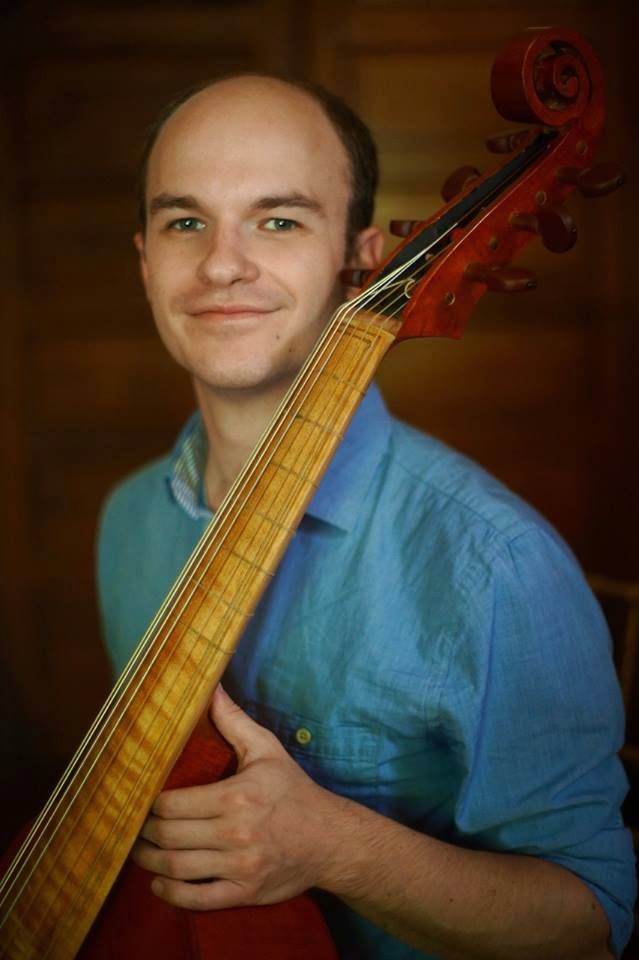
Thanks to the generous scholarship from Catacoustic Consort last spring, my early music life has started to blossom. The scholarship allowed me to purchase a beautiful seven-string bass viol and it has been a catalyst for many opportunities in the early music community this year. In September and April, I was fortunate enough to participate in two of Catacoustic's performances, "He Who Sings, Prays Twice" and "The Turn of the Year," both of which were monumentally inspiring experiences. In February, I participated in two different events as part of Cincinnati's Early Music Festival: a set of four intimate concerts of assorted viol trios in local public libraries, and a rousing performance of "The Cries of London" by Orlando Gibbons during Classical Revolution at Northside Tavern. While wrapping up my master's degree in viola performance at CCM, I played in two viol consort performances as a part of the Early Music Lab and played the bass lines for a student performance of Strozzi's "Hor che Apollo." It has been quite a busy year!


I am so excited for what the future has coming my way. This June, I will be attending Oberlin's Baroque Performance Institute to dive a little deeper into the world of early music. I look forward to further exploring an area of music that I have loved for so long in such an intense, focused, high-level atmosphere. In the fall, I will be starting a Doctor of Musical Arts in viola performance, and I hope to incorporate early music studies into my curriculum as I continue with my professional and personal development in music.


I owe a huge thanks to Catacoustic Consort for their generous scholarship. Purchasing my own instrument has served as a gateway to so many opportunities, and it wouldn't have been possible without their help. I'd also like to thank my teacher, Annalisa Pappano, who has been such a strong source of support, inspiration, and encouragement over the past several years!

And from Cole:
I am so fortunate to have been one of the 2014 recipients of the Catacoustic scholarship. With the money received, I was able to purchase my first viola da gamba. In the past three years, I have grown increasingly close to this instrument. Its music, its history, its society, from my first encounter to the present, have been a source of intrigue and delight. 

Experiencing the cantata cycle Membra Jesu nostri with Catacoustic this fall was a remarkable experience that I will treasure always. It was a privilege to work with Annalisa and her colleagues on such a fantastic work. 

At the moment, I am pursuing a music career, however small, focusing on bringing the gamba and Baroque performance practice to the rural Midwest (my home). I am excited to bring the fascination I have developed for this music and culture to an equally interested group in eastern Iowa.

Sunday, February 1, 2015

Catacoustic Early Music Scholarship Winners -- Where Are They Now?


This spring Catacoustic will award its 5th Annual Early Music Scholarship. Here’s a check in with our past award winners:

Way back in 2011, our first winner was Elizabeth Motter. An accomplished professional harpist,
Elizabeth was interested in taking on the Baroque triple harp. It turns out the difference between a modern pedal harp and the Baroque triple harp is substantial. She began her journey at the Accademia d’Amore in Seattle, courtesy of the Catacoustic scholarship.  Since then she has attended Tafelmusik and Oberlin’s Baroque Performance Institute, and had coaching with a variety of continuo players. It’s been a real challenge, but the work has been paying off. Elizabeth has played now with University of Cincinnati College-Conservatory of Music in several Monteverdi projects, in Minneapolis with Consortium Carissimi, with Catacoustic (including two concerts this season), and for Cincinnati Opera’s presentation of La Calisto. Here’s how Elizabeth sums up her growing involvement with early music in Cincinnati:
 
“I consider myself fortunate to have people here in Cincinnati to play baroque music with, and a community of baroque-curious, with whom to learn, such as the many singers from CCM who have agreed to do various projects for free in exchange for coaching. And slowly the community here is growing, as a result. It is important to have a community of people to actually play with. I have heard from baroque harp players in other cities that they don't have people to collaborate with on a regular basis, that there is no local early music community, so I am extremely grateful to be in a place that offers such opportunities.”


Our second award, in 2012, was given to Micah Fusselman, enabling him to purchase his own viola da gamba. Micah has since moved to Omaha, Nebraska, where he is teaching viol to four adult students and several children. They are on the brink of beginning to play in consort with each other—quite an achievement after less than two years!  

Micah also plays himself, of course, including an upcoming series of Bach Gamba Sonatas. He also loves playing with his students. “I've been using the gamba quite a lot working with my cello and violin students, actually. I've learned to play bass lines and realize continuo at the same time so that I can accompany various 17th and 18th-century sonatas. It's a real challenge for me, but it works very nicely in some pieces and the students learn a lot about the style. My students have become so accustomed to me accompanying on the viol that they never mention it anymore. It's funny when a new student shows up to a group class and sees the gamba for the first time, is amazed and aghast, and my other students calmly give him or her the rundown.” What a delight to think that a community of early music-savvy people is coming up in Omaha, and Catacoustic had a hand in the making of it!

The award in 2013 went to Michael Zaret. Michael was once a professional recorder player (his
group, Musica Camerata, toured, and even performed on “A Prairie Home Companion”.) Over the years that had slipped into the background. But there came a time when he realized he was ready to get back to playing. His lovely collection of recorders was showing the years of neglect:  the scholarship allowed him to have them refurbished and returned to performance quality. And because a talented recorder player is always in demand, Michael has become a sought-after member of many groups around town.

Michael plays regularly with Consort in the Egg, which features mostly wind instruments and very early Renaissance music (playing Feb 10 at Live at Lunch at Christ Church Cathedral); Cincinnati Recorder Consort, which combines pros and amateurs and explores all kinds of repertoire; Noyse Merchants, which specializes in authentic instruments and Renaissance music; and sometimes he sits in with Ubi Caritas, a Baroque wind band. He is also active in several pick-up groups. His motto is essentially “Will Play for Fun.” He’s branching out into the worlds of Baroque flute, cornettino, and cornamuse. Michael’s day job is as a teacher at Skyward Academy, where he teaches junior and high-school kids on the autism spectrum to play recorder and read music. He’ll also give recorder lessons to adults:  this could be your big chance!

In 2014, we were fortunate to be able to make two awards. These were to two young men who started out at CCM studying conventional instruments – cello and viola respectively – but who have been seduced by the wonders of early music and the viola da gamba.

Cole Guillien is hoping to go to a historical performance program, perhaps at Oberlin, Peabody, or Julliard, next year. Till then, he’s busy playing with Catacoustic, the Shakespeare Band, and solo. He attended this summer’s Viola da Gamba Conclave, where he met like-minded musicians from around the country. And he’s starting to think about adding Baroque cello to his resumé.  Cole freely admits, “The world of historical performance is starting to consume my life from all angles .” 

Stephen Goist is wrapping up his Master’s degree in viola performance at CCM. But he’s been studying viola da gamba on the side for four years, and has fallen in love with early music. The scholarship has made it possible for him to own his own instrument. “I hope to explore a wide range of music for bass viol, including continuo accompaniment and solo repertoire. I hope to continue to perform as a part of the early
music community in Cincinnati and even perform a solo recital sometime in the future.” Save us a front-row seat!

Applications for the 2015 Catacoustic Consort Early Music Scholarship are open now, and will be due April 1. We encourage all members of the community who are serious about early music to apply. Details and applications can be found at our website, catacoustic.com