
I will continue the Baroque cello theme in several weeks when I travel to San Francisco to play in the SFEMS series (sfems.org) in a collaborative concert between Catacoustic and Wildcat Viols. Three of the musicians in that ensemble are Baroque cellists (Joanna Blendulf, David Morris, and Elisabeth Reed), and I look forward to getting their insight. If any readers have questions they would like posed about Baroque cello, please comment in this blog or send an email to info@catacoustic.com.
Stay tuned!
Friday, August 26, 2011


Saturday, August 20, 2011
Baroque Cello Masterclass with Jaap ter Linden


In keeping with the Baroque cello theme, I attended a masterclass by Jaap ter Linden, who was teaching at the Vancouver Early Music Workshop. Jaap is one of the premier Baroque cellists today, and he is highly respected for his teaching, performing, and direction. To find out more about Jaap and his international career, see his website at http://jaapterlinden.com/about.php.
The students at Early Music Vancouver were all college-aged and very enthusiastic, and it was great to see young people so excited about early music (attending all the concerts and lectures). This is the next generation of early music performer! At dinner one evening, Amanda Keesmaat said that she was going to observe a class with Jaap der Linden, so I decided to go along with her and write about it for the blog. I paraphrased what Jaap talked about in his masterclass.
Jaap began the session talking about technique: bow arm comfort and flexibility and the importance of having a straight bow. There were five students in the masterclass, and they were primarily new to the Baroque cello. Jaap talked about how to creatively leave the auto pilot mode of “modern” playing. The question is how to get comfortable with this change. I like to create exercises. Pretend that your fingers are glued in place to the bow, and move your hand at different angles. Then, practice scales. It is so important to keep practicing scales! Then, there is the matter of the elbow and its role. If you take a photo of your bow arm, you should be able to see if it is in down or up bow mode with the wrist and elbow.
A student asked, “How do I know when I get there?”
Jaap responded: That is an interesting and somewhat dangerous question. It is like saying “how do I know if I am enlightened?" It is a Zen journey. This will happen when you listen to your body and increase your body awareness. When I am in a good place, I feel very comfortable and light. My ears tell me the sound is good. You will feel a flow, and the sound comes more easily. Look, watch, and listen. Trust your ears. Ask yourself, “am I breathing?”
Students played a sonata for solo cello with bowed bass
Jaap: You do all the right things: not too much vibrato, note shaping, yet there are many more stops to go on the bus. Your sound is off the floor because of the great care you take. You are more upright than grounded. You can get more resonance out of the instrument – a type of buzz and ringing. Seduce the cello, just like the sirens seduced the audience in the concert we heard of Purcell’s King Arthur. Wake up the cello. This begins with breathing at the beginning of the stroke. Breathe from your abdomen (gestures just above hips). Before you do anything sophisticated, you need to get the basic quality of sound. Think of a singer and how they warm up to find their resonance. As cellists, we have to do the same.
The student started the sonata a second time with a much more resonant sound.
This is the road! Get the intensity, and then you can start doing more. There are so many elegant possibilities! Jaap talked about intonation and mentioned that the C#’s should be lower.
This is a start. There is a list of possible questions.
I would like to ban the notion that “Baroque music is nice.” No! It is nice, but it is everything! It is passion - Hollywood tearjerker material! Do not give the impression that we are only polite and correct musicians.
Another student played Vivaldi’s Sixth Sonata, Third movement with bowed bass.
Jaap corrected a mistake in the edition. Slurs can help you out or get in the way. This piece is full of biting harmony. Think of where the dissonances are and get a harmonic picture. Aim for the dissonances, but everything shouldn’t always be strong. Solo and bass lines form a type of lament. Look for places of respite (cadences). Find new colors. It is like theatre, when lights change immediately. Find more colors.
Be aware of intonation. Where are your B-flats and C-sharps? Be colorful with intonation. Watch out for your leading tones. (He then worked on finding pure thirds, where one student would play the root of a chord – “D,” with the major third above “F-sharp.” When you come from modern cello, most people cannot find pure thirds on their instrument. Strangely enough, finding the pure third is an innate universal skill. If you play a D and sing the third above in your head, then play it, it will be pure. It is much harder to sing the modern intonation F-sharp. A good suggestion for an exercise book to practice intonation is a book for modern cellists, Melodic and Progressive Studies by Sebastien Lee (http://www.amazon.com/40-Melodic-Progressive-Etudes-Op/dp/0793548713/ref=sr_1_1?ie=UTF8&qid=1313892484&sr=8-1 ). This is excellent practice for double stops and interval practice. Diatonic semitones should be big and wide, like C-sharp to D. (He then demonstrated by playing an A with a D, then C-sharp versus D-flat. This intonation ideal changed recently with the advent of music being thought of as vertical versus horizontal.
You should listen to a recording of Edith Piaf. She is an intense singer, who sang “Les Blouses Blanche” (http://www.youtube.com/watch?v=HAqXNgQAiq4). She paints a picture and changes colors, much like in this sonata. Everything in your playing was nice but the same color. Drama! Give more structure. I hesitate to tell you what to do, but change the intensity of notes.
Nathan Whitaker, Baroque Cellist

Nathan Whitaker, a Seattle-based Baroque cellist, was at the Vancouver Early Music Festival, where he played in Early Music Vancouver's production of King Arthur (Purcell). I thought it would be the perfect opportunity to interview him about his experiences with the Baroque cello. Why not make this Baroque cello month?
How did you learn to play the Baroque cello?
I attended Indiana University for my undergraduate and masters degrees, where I took Stanley Ritchie’s (Baroque violin professor) unaccompanied Bach class. This wetted my appetite for Baroque music, so I signed up for secondary Baroque cello class. I took lessons with Shelley Taylor and later with Stanley. I was able to borrow an instrument from the university, and now I have my own Baroque cello.
What is your musical background?
Both of my parents are professional church organists, and I started piano lessons starting at the age of three. I began cello in the third grade with my school program. I was in high school when I decided that I wanted to make music a profession. I am now finishing my doctorate degree at the University of Washington.
What are the technical differences between the Baroque and modern cello?
1)The differences between the “upbow” is big. Modern cello is always about sustain and creating an even sound. Baroque bowing is more like talking with strong versus weak bows. It is concerned with how the upbows are treated.
2)Intonation is treated differently. Baroque music has lower leading tones, whereas the modern cello has the Casals “expressive” tuning of higher leading tones.
3)Vibrato
4)The Baroque cello is held at a mover vertical angle, versus the horizontal angle for modern. It is easier to reach higher positions on modern cello.
Who are the good teachers for Baroque cello? Do you teach?
I learned the most from working with singers and violinists. As cellists, we must accompany others. We must learn how to enhance their music.
Jaap ter Linden is an amazing teacher, as well as Phoebe Carrai.
I teach privately and now at the new Baroque program at the Cornish College of the Arts in Seattle (http://www.cornish.edu/music/early_music/). We have an undergraduate degree program and performer’s diploma. We hope to offer graduate accreditation soon.
I have noticed a certain amount of difficulty for cellists to approach the sound world of the Baroque cello. Would you comment on the importance of immersion in Baroque style and music? Do you still play the modern cello?
It is so important to be immersed in Baroque style! It is like learning a new language. When you take high school French class for one hour a day, five days a week, it is helpful, but you never really become fluent. If you want to learn a language, you must go to the place where it is spoken. There are so many things beyond the vocabulary to learn. Then, after a while, you can go back and forth quickly.
I do play modern cello: I play Classical and early Romantic music, so there is a continuous spectrum in what I play. Music is always changing, but this change is gradual. I am playing the Shostakovich concerto soon and his trio later today! This variety keeps me balanced. Personally, I need more than one period of music, and it helps to keep things in perspective.
What kind of Baroque cello playing do you do? What would you like to do?
I play in the Seattle, Pacific, and Portland Baroque orchestras, as well as the Seattle Baroque Soloists (an offshoot of Seattle Baroque). I also play in the chamber group Plaine and Easy, which won a competition not so long ago. We play Elizabethan music. I also play in Opus 20 String Quartet, which plays Classical period music on period instruments. I would like to do more solo recitals.
What is your advice for modern cellists who might be interested in learning to play the Baroque cello?
1.It is not easy to play Baroque cello. Just because the notes look easier doesn’t mean anything. You must practice your scales and etudes to become a complete musician.
2.Play as much music as you can. Bass lines can seem formulaic at first glance, but you need to learn when they are different and see the music between the notes.
3.Work with inspirational people – especially singers!
4.Record yourself. There is so much detail to think about, and it is hard to know if you are actually doing things that you intend to (like releasing second notes of a slur). It is good to have external confirmation.
5.Studying with someone is ideal.
6.It is important to read the sources.
What are these sources?
A good place to start is to read the book 100 Years of Violoncello. It has a good list of resources to read.
What cello do you play?
I play a Gustav Greiner, made by Breitenfeld in 1875. My bow is by Ralph Ashmeade.
To learn more about Nathan or to contact him about lessons, visit his website at www.nathanhwhittaker.com.
Friday, August 19, 2011
Amanda Keesmaat, and Her Journey with the Baroque Cello

I just returned home after a month of wonderful concerts throughout Canada with some incredibly talented musicians. It isn't very often that I play with Baroque cellists, so it was a delight to once-again work with Amanda Keesmaat, a Montreal-based Baroque cellist. Amanda has a beautiful tone and a real sensitivity that add so much to the ensemble. I frequently have people approach me with an interest in Baroque cello, which I do not play, and I thought that my time with Amanda would be the perfect opportunity to ask her some questions that could help others who may be interested in learning to play the Baroque cello.
1)How did you learn to play the Baroque cello?
I was a student at McGill for my artist diploma. I studied Baroque music as an elective, where I took orchestra and chamber music classes. Soon after, I started playing with Orchestre Baroque du Montreal (OBM). McGill had an instrument I could borrow and an excellent group of teachers. I didn't have a private instructor, but I learned over time from other musicians, coachings, isolated lessons, and music directors. Hank Knox is the director of the McGill Baroque orchestra. It took a while just to figure out how to hold the instrument, and later – bit by bit, I learned the details of style. I played for and worked with Betsy McMillan (founding member of Arion), Jaap ter Linden, Phoebe Carrai, and Susie Napper, amongst others. I learned a lot from them.
When I am hired, I listen to the desires of the music directors. Every group has a different idea of sound or musical direction, and I like that. That is how one learns, and it is good to be flexible!
2)What is your musical background?
I started cello when I was four years old. I got my BM from the University of Western Ontario and later went to McGill, where I studied (modern cello) with Antonio Lysy. It was during this time that I started Baroque music. Actually, I joined Baroque Orchestra because my roommate was the violone player. I loved it! Prior to this, I was interested in contemporary music, and I have now played Baroque cello for fifteen years!
3)What are the technical differences between Baroque and modern cello?
Technical: How you get the sound out of the instrument and how to get the string to speak. Wow! It is hard to put it into words. You have gut strings and have to draw the sound out with a pull, rather than with force. You have to coax the sound out, rather than spinning it out.
The bow hold is different. It is held further from the frog – between the frog and the balance point, rather than on the frog.
The cello is supported with the legs: no endpin is used. (Strangely enough, there is no juxtaposition of terminology for “cello” and “da gamba” that has been found.) Because of one's size, one's body dictates the position of the instrument to a certain extent. The Baroque cello is more in contact with the player, whereas the modern cello is kept at a greater distance.
Left hand:
The biggest thing is a concept of tuning and ear training. I play in different temperaments, depending on the decision of the group. I have to be aware of where to place accidentals and how that affects the tuning of the group. It is always important to be aware of what part of the chord the note is for the context of the note and for tuning.
The use of vibrato is always an issue that affects tuning, as well as tone. When I began Baroque cello, I was told to play without vibrato, but as a modern cellist, I had been trained to vibrate everywhere! That was EXTREMELY difficult to eliminate at first, but then I realized that vibrating ALL THE TIME didn't necessarily mean that I had control over the sound, either. For example, it is difficult, if not impossible, to practice intonation with vibrato constantly changing the pitch. That being said, vibrato should not be discarded! It should be used as an ornament or at least very consciously.
4)Who are the good teachers? Do you teach Baroque cello?
There are many great teachers and summer festivals as well. The people who were my mentors and colleagues were great for me. I also teach Baroque cello.
5)I have noticed that it is often the case that those who play modern cello have a certain difficulty approaching the sound world of the Baroque cello. Would you comment on the importance of immersion for “switching hats” between instruments? Do you still play modern cello?
My advice is to be patient and take your time. With enough exposure, little-by-little, one notices things to change with the body that can help to play Baroque music in a more stylishly appropriate manner. In general, you need to be really relaxed to play the Baroque cello. I think that you can do both, but it is difficult. Isabelle Bozzini in Montreal (Quatuor Bozzini) is a good example of someone who does both.
6)What kind of playing do you do on Baroque cello? What would you like to do?
I play mostly bass lines for orchestras and chamber ensembles. I am very happy in the continuo section. I have done more solo playing the past few years, but I am quite busy now with concerts and find it hard to find time for personal projects. In a dream world, it would be nice to spend six months to attack new solo repertoire. I would play as much as possible and know the background for the repertory for my instrument better. That way, if someone requested a sonata from a certain place and time, I could better suggest programming.
Last year I was the invited guest for a concert with the Ottawa Baroque Consort. It was a concert featuring the cello and it's origins. I learned a lot from this and had fun. It was great to do this research and learn new rep! Especially, it was exciting to play with another cellist and talk to the audience about where and when the instrument's journey began.
7)What is your advice for modern cellists interested in Baroque cello – especially if there is no one near them to teach?
1. Experiment with a different bow hold. Hold the bow higher, with the middle two fingers on the hair to get the feel and balance of a Baroque bow.
2. It is really important to have the contact and guidance of a mentor. You can’t really learn Baroque cello without having someone who knows how to talk about the physical feelings, sound and style. Even if you are a professional cellist, you need some input.
3. Listen to as many period recordings as possible. I like Sergei Istomin’s Bach recording.
4. Practice without vibrato and see how you can make the sound carry without that factor.
5. Practise sonatas with another cellist or bass player to listen to the chords. Let the harmonies help you decide how to phrase.
8)What cello do you play?
I play a Baroque cello by Roland Ross (England), 1989 with bows by Louis Begin and Louis Gaucher.
Monday, July 25, 2011
New Friend on Summer Concert Tour: Montreal's Margaret Little


I am spending this month in Montreal, playing with the talented musicians of Matthew White’s ensemble Les Voix Baroques. Lucky me, I am staying with Margaret Little, a Montreal-based viola da gamba player, who is also in this concert and took the time to tell me about her life in early music. Margaret is one-half of the duo Les Voix humaines (www.lesvoixhumaines.org), whom anyone who has taken a few minutes to peruse the early music section of a CD store would recognize from their numerous recordings (around 30!).
Margaret grew up in a musical family. Her father was an organist and choral conductor who collaborated with the Montreal Consort of Viols with his choir. When Margaret was only eleven years old, she attended a music camp as a violinist, where she studied viola da gamba with Gian Lyman Silbiger. Margaret fell in love with the viol and its music and returned to Montreal determined to pursue her newfound interest. She saved the money for her first treble viol by teaching guitar lessons. (Remember, she was only eleven!)
Margaret met Susie Napper (the other half of Les Voix humaines) after Susie had moved from San Francisco to Montreal. They both had daughters the same age, so they met so the girls could play together. The moms did, too! This was how a magical, musical friendship through Les Voix humaines was born! Margaret says that their main interest is communicating and expression through their music. Their recording career began with their love of the music of St. Colombe. (Many of you may remember St. Colombe as the father/viol player in the movie Tous les Matins du Monde.) These duos are extremely esoteric, and they spent much time figuring out this complicated music and recorded all 67 of them on four double CD’s. They have a good relationship with their recording label, ATMA, and occasionally ATMA will offer suggestions for recordings or help with long-range plans.
Margaret and Susie spend a lot of time together for each project to try new things out and let the music grow and develop. Now, an important part of their musical life is in making arrangements of music for two viols or viol consort. They hope to make these clever arrangements available to the public! They also collaborate with other artists, such as Wieland and Bart Kuijken, Suzie LeBlanc, and viol players in consort. Les Voix humaines has participated in the Montreal Baroque Festival (see www.montrealbaroque.com).
Initially, they performed concerts in Susie’s home in a series of three to four concerts each year. Susie would cook amazing food to accompany these programs. Later, they moved the series to a church in Montreal. Margaret and Susie obtained an agent in 1994 to give them more opportunities to play. They have traveled all over the world with their music: Australia, New Zealand, Mexico, the U.S., throughout Canada, Israel, Japan, China, England, France, Belgium, Holland, Poland, and the Czech Republic. In the U.S., they have performed in Honolulu, St. Paul, St-Cloud, St-Croix, Tucson, Colorado Springs, Seattle, San Francisco, San Diego, Los Angeles, New York City, Cambridge, and Boston. They often coordinate these programs with lectures and workshops, often in cooperation with the Viola da Gamba Society of America.
Les Voix humaines has some goals for the future that we can look forward to. This year will feature consort music by Trabaci, as well as their focus on free improvisation. They will record Bach’s “Art of Fugue” and a duo Bach program – Susie’s arrangement of his Italian concerto for two bass viols.
Montreal is an exciting city, where there is so much early music happening. There are approximately twelve early music ensembles or series in this city! Margaret is one of the people who paved the way for this type of environment, and she is investing in its continued success through the collaborative development of a parent organization, Montreal Baroque. They are developing a website with links to performers and groups and a calendar for all early music performances in the city to help avoid planning conflicts for ensembles, but also to publicize concerts. The society may invite groups from abroad, will mentor young groups, and may offer a series for local groups without their own regular series.
Margaret teaches viola da gamba and Baroque ensemble at the University of Montreal. She primarily plays viol, but she also enjoys the Baroque viola and often performs both instruments in one concert. Margaret recorded a CD for unaccompanied viol and has many solo recitals planned with Montreal lute player Sylvain Bergeron. Her favorite music is sacred music with singers, like the Bach Passions or Christmas Oratorio. She commented, “I like being a part of a big group celebration of things spiritual.” Through her investments in making recordings, concerts at home and abroad, teaching privately and at university, ensuring the city’s future in early music with Montreal Baroque, and future musical goals, she is certainly involved in a big group celebration!
Monday, July 11, 2011
A Match Made in Heaven Pt.1


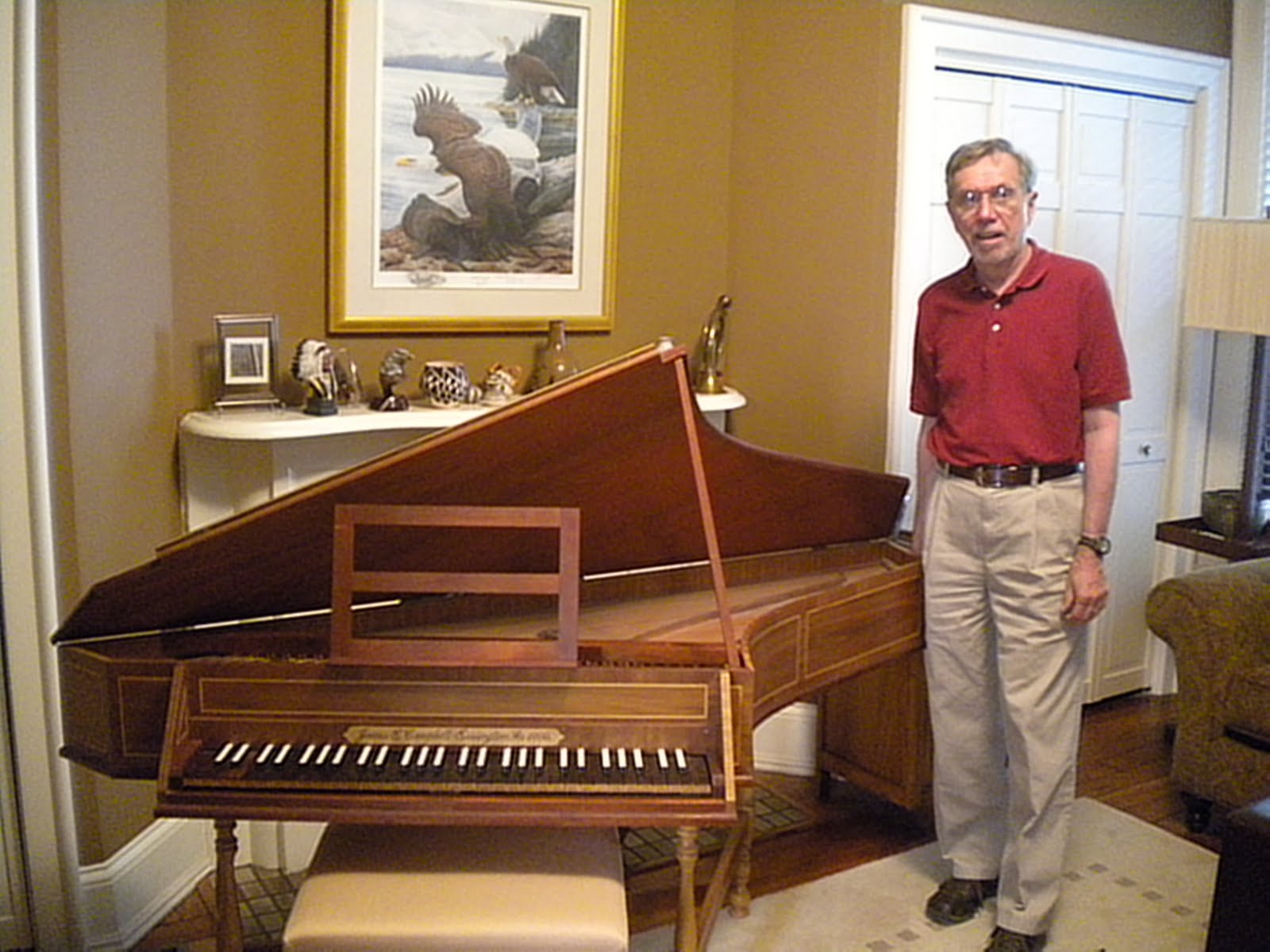

My husband called from work the other day with some bad news. He works for Cincinnati Opera, and the keyboard glockenspiel that they rented for their upcoming production of The Magic Flute arrived broken (see bottom photo). He was at a loss for what to do. I suggested that he call James Campbell in Newport. Few people would ever guess that Newport, Kentucky (just across the river from Cincinnati) is home to one of the best American early keyboard makers. James built Catacoustic’s harpsichord, and he generously keeps it in excellent playing condition. Needless to say, Jim saved the day for the opera by fixing the damaged instrument in less than one day.
James and his wife Nina Key-Campbell (harpsichord player) live in a beautiful historic home surrounded by early keyboard instruments – many of which they crafted together. There are four harpsichords (plus one in process), three clavichords, an organ, and an upright piano. It is a beautiful, amazing sight!
In 1963 Jim was a school teacher in California. He had taken piano and organ lessons, and decided that he wanted a harpsichord. He bought a kit, which was the easiest way to make one at the time. After playing the instrument for a while, he decided that he wanted a larger instrument – a French double manual. Jim went to the LA library to research how to make an instrument without the aid of a kit. In 1973, Jim made his first original instrument in Cincinnati. At that time he was an editor for a religious publishing house, and instrument building was relegated to his spare time.
Several years later, he was inspired to make a small virginals by an instrument that was housed at the Cincinnati Art Museum. This point in life saw Jim working for an engineering firm as a model builder. His next incarnation was as a piano tuner/technician and instrument builder.
Jim and Nina met in 1978 at a concert she gave at Clifton Calvary Church. They began collaborating soon afterwards. Nina apprenticed with Jim to learn piano tuning and was his assistant for instrument making.
Jim made a series of instruments up to 1984. He doesn’t even know where all his instruments are. He made several instruments for Nina and a French double for Northern Kentucky University (still in use). He built 25 keyboard instruments and rebuilt approximately 10.
In 1986, he retired from his keyboard work to be an Episcopal priest and educator in Chicago, Philadelphia, and later southern Kentucky. During that time, he made only one instrument. After he retired from full-time church work, he returned to instrument building and repair by making an instrument for a church in Lexington. Nina assisted him for this project, and they married in March of 2009! It is a match made in heaven!
In June of 2009, he began to take care of the harpsichords at the University of Cincinnati College-Conservatory of Music (CCM). He worked on instruments at the University of Kentucky, the University of Dayton, and the University of Nebraska (Lincoln).
Jim and Nina are constantly looking for new projects to tackle. Last December they reassembled a tracker three stop organ that is currently in their living room (see photo above). Jim is currently making a new instrument for Nina in his shop. “We felt we needed a Flemish harpsichord, since it is the quintessential instrument of the 17th century, and Jim was doing research and wanted to incorporate his ideas into an instrument.”
Jim is not active in seeking commissions, but he wouldn’t say no. He doesn’t want to be rushed during his retirement. Jim compares it to a commercial for a Scottish golf club maker: “The waiting list is five years long, but there are four people ahead of you.” He has no concrete goals for the future, save to enjoy what he does every day. Jim enjoys making instruments for his wife, working on his model railroad, reading, walking, and traveling.
A Match Made in Heaven Pt.2
Nina Key-Campbell grew up in the Pacific Northwest surrounded by music. She started to play piano by ear at the age of four and began formal music lessons in the first grade. She studied organ in college, when Arnold Dolmetsch came to visit her school and brought along a small harpsichord. Nina fell in love with the sound of the instrument and locked herself in the studio with the instrument all day, skipping classes to play. The next year an organ professor arrived at the university who also played the harpsichord, so Nina studied both instruments. She received a Fulbright to study organ and harpsichord in Holland with the great Gustav Leonhardt. Nina took full advantage of this wonderful opportunity, taking many classes with the master – and was able to take three classes a week with him!
When Nina returned to the US, she studied at the University of Illinois with George Hunter and was the first recipient of a Master’s degree in harpsichord performance at the school. She married and moved to Syracuse, NY, where she played often. She had a family (two daughters) and purchased her first harpsichord.
Three years later in 1968, she moved to Cincinnati, where her husband was the first music librarian at CCM. Nina taught piano and performed in Cincinnati. She played with numerous formations of early music ensembles: recorders, cello, violin, and singers. She worked with Ben Bechtel (instrument maker and musician) to develop an early music series. Nina taught keyboard and aural skills at Northern Kentucky University for 22 years and tuned pianos for 10 years. In the 1989, Harold Byers, James and Barbara Lambert, and later Rod Stucky joined Nina to form Apollo’s Cabinet (formerly Baroque Chamber Soloists). They still perform concerts at Christ Church Cathedral, the Taft Museum, and other local concert series.
Nina has many musical goals:
1. A solo recital at Christ Church Cathedral on April 10, 2011 to celebrate the church’s new harpsichord purchase.
2. Nina and Jim love to show their instrument collection through open houses. They had an open house in the Spring for the MacDowell Society and another for advanced placement students at Indian Hill schools. They plan to invite friends and neighbors to see the instruments.
3. Scarlatti Project: Nina is doing an in-depth analysis of Scarlatti sonatas with commentaries. She is working with a statistician from Iowa State to run descriptive statistics of idea sequences. There are 563 total sonatas, and she has done 450 total. She presented a paper on this in Spain and would like to write an article and include this information on a website to be available as a resource for researchers and performers.
Jim and Nina are both involved in a joint meeting of the Southeast Keyboard Society and the Midwestern Historical Keyboard Society in Cincinnati in March of 2012. There will be two competitions: the Alienor Competition for new works and the Jurow Competition for harpsichord performance. Scholars will present papers, concerts will be performed, and instrument builders will bring their instruments to display. This will all take place at CCM! We are so lucky to have energetic and talented forces such as Nina and James here in the Greater Cincinnati region!
Subscribe to:
Posts (Atom)
